Blog
Practice
The practice itself: how to notice where attention is, and how to return. Short, and meant to be tried, not read.
Tie your camel, then trust: the essence of Islam, seen through one map
Tie your camel and trust in God, seen through one map: do what is in your hands now, and leave the outcome where it lives, in the future row. Fifth in a series.

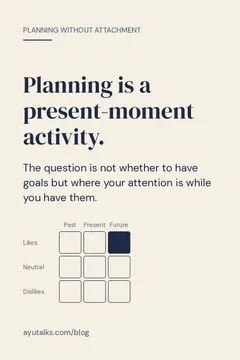
Can you live in the present and still have goals? Planning without attachment
How to live in the present and plan for the future: the problem is never having goals, but where your attention goes while you have them.
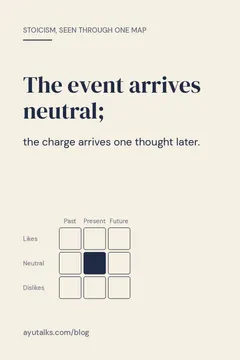
Stoicism and the present moment: the Stoic view of worry, seen through one map
Stoicism and the present moment, seen through one map: what is up to us, the judgment added to events, and why only the present can be borne.
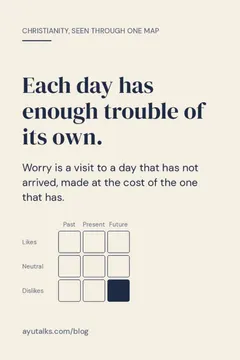
Do not worry about tomorrow: the Christian teaching on worry, seen through one map
Do not worry about tomorrow: the Christian teaching on worry, seen through one map. Tomorrow lives in the future row; the day's trouble is met in the present.
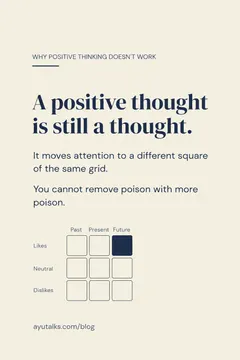
Why positive thinking doesn't work, and what does
Why positive thinking doesn't work: a forced good thought is still a thought, pulled away from the present. What helps is noticing where attention is.
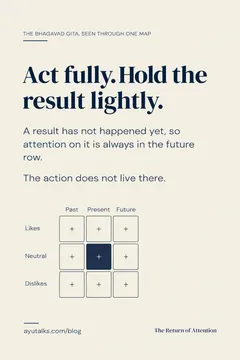
Acting without attachment: the essence of the Bhagavad Gita, seen through one map
The Bhagavad Gita on attachment, seen through one map: act fully, hold the result lightly. The result lives in the future; the action never does.
How to stay calm: you return to calm, you do not hold it
How to stay calm when life pushes? Not by holding calm tight, which is its own tension. Calm is where attention rests when it stops pushing and pulling.
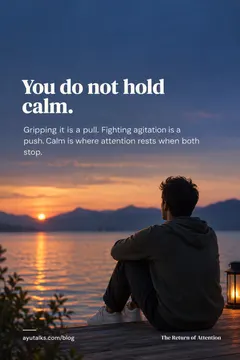
Image: AI-generated
Why does exercise reduce stress? The relief is attention being forced into the present
Why does exercise reduce stress? A run or a cold plunge demands so much attention that the mind cannot stay in the past or future. The relief is borrowed.

Image: AI-generated
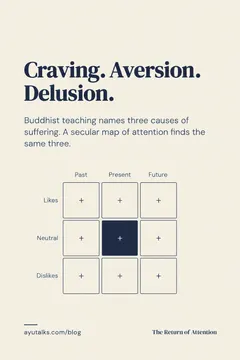
Craving, aversion and delusion: the essence of Buddhism, seen through one map
Buddhist teaching names three causes of suffering: craving, aversion and delusion. Seen through the nine attention states, each one can be found in a second.
How to be more present: the state you do not have to build
How to be more present is the wrong question. Present + Neutral is the only one of nine positions that starts no chain reaction, and it is not built.
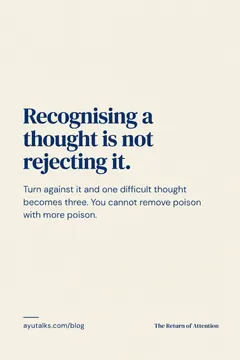
How to control your thoughts: recognising one is not rejecting it
How to control your thoughts starts with one mistake to avoid: treating recognition as a verdict. That replaces one difficult thought with three.